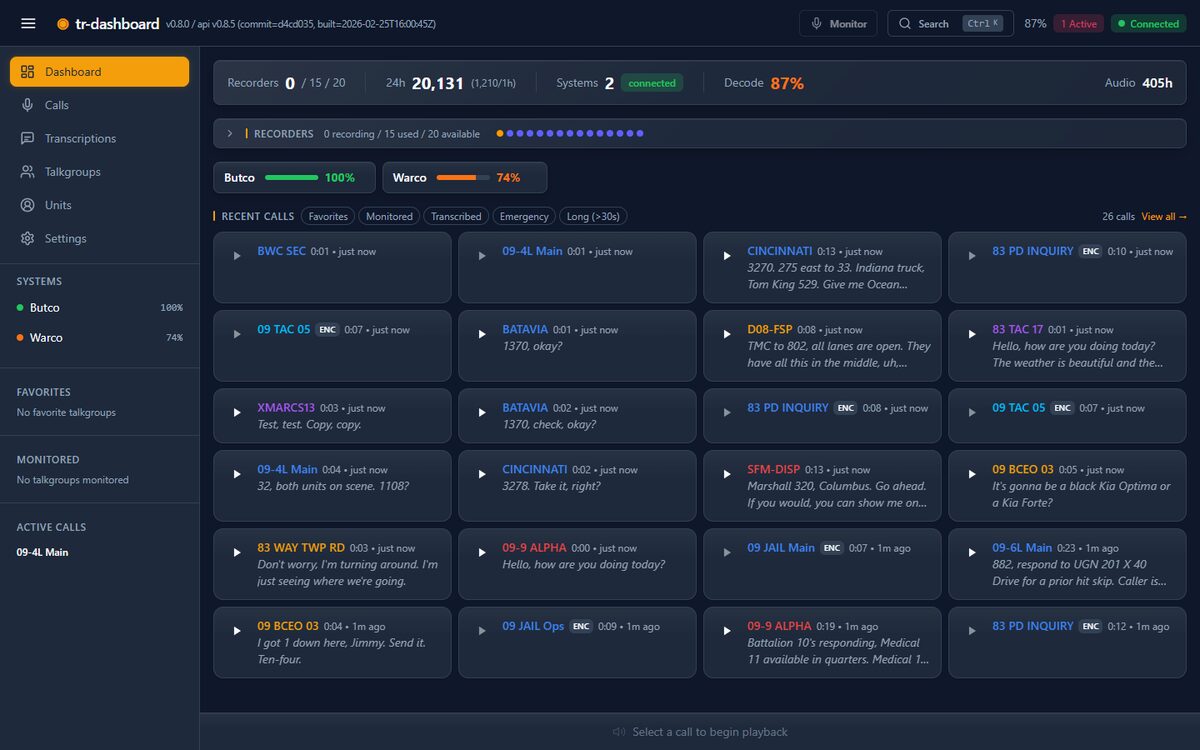
If you record your local police and fire radio with trunk-recorder, this turns the pile of recordings into a website you run yourself. Calls show up as they happen, each one written out as text, with a search box over all of it.
Who said "structure fire" on fire dispatch last Tuesday? Type it in. The public demo follows a statewide system in Ohio and holds over two million calls.
calls as they come in, each with its transcript
Runs on your own computer with no cloud account, even on a Raspberry Pi 5
Works with the trunk-recorder you already have. If you upload to OpenMHz or rdio-scanner, keep doing that; this takes the same uploads
Keeps everything, for as long as your disk allows
your antenna
│
trunk-recorder # records the calls, as before
│
tr-engine# keeps them and writes them out
│
tr-dashboard# the part you look atimbe-asr# optional: transcription at home,# built for radio
The part that keeps everything. Install it once and forget it's there.
Every call gets written out as text, by a paid service if you have one or by the free model below if you'd rather not pay anyone
Learns the system as it listens: which radios use which channel, and when they come and go
It also learns what units call themselves on air. If a radio keeps saying "Medic 12, on scene", it suggests naming that radio Medic 12, and you click approve
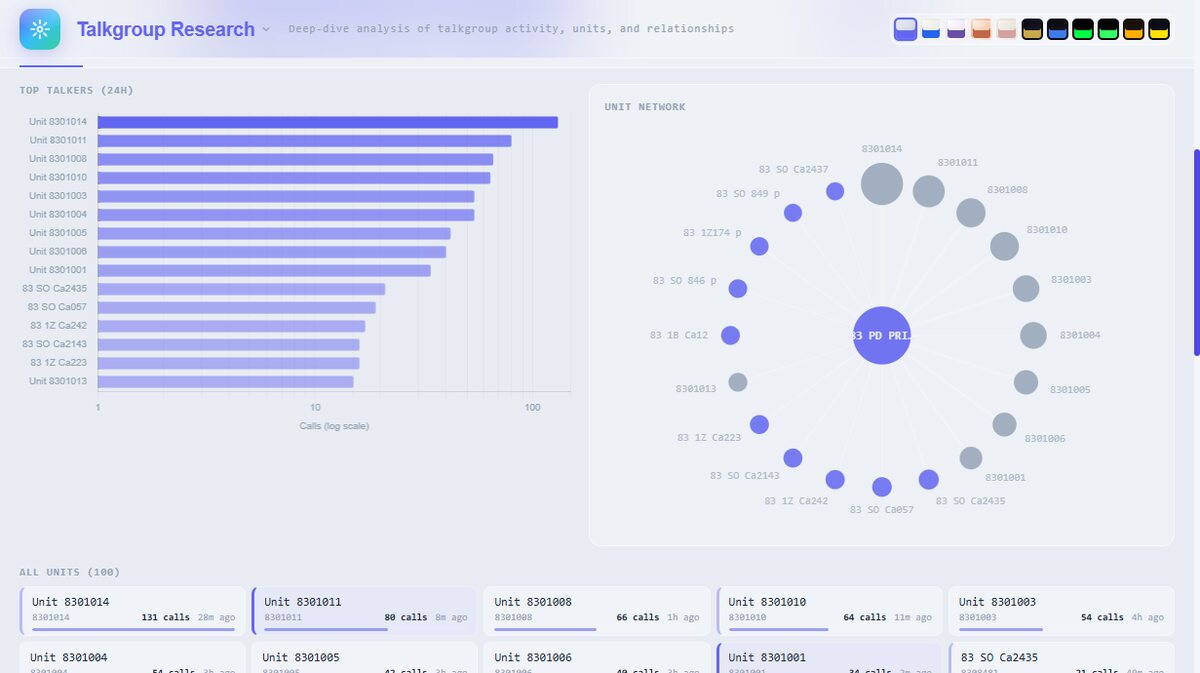
who talks most on one channel, and who they talk to
Free transcription at home, built for radio rather than for podcasts.
Digital police radio doesn't actually send sound. It sends a compressed description of the voice, and the scanner rebuilds the sound from that. The usual way to transcribe it is to rebuild the sound first and hand it to a general speech model. This model skips that step and reads the description directly, so nothing gets lost on the way.
# the usual way
 radio ─▶ compressed voice
       ─▶ rebuild the sound
       ─▶ guess the words

# this way
 radio ─▶ compressed voice
       ─▶ guess the words
no sound is ever made
Fast enough for a whole radio system: a 10-second call takes a few thousandths of a second on a gaming graphics card, and under a second on a Raspberry Pi 5
Honest caveat: real dispatch audio is hard, and it still gets about one word in five wrong
If you'd rather do it the ordinary way, there's also a regular speech model trained on real radio calls on Hugging Face
published march 2026. A proper hand-checked test set is still the open job.